Showing posts with label Phase 3.2 - Probes. Show all posts
Showing posts with label Phase 3.2 - Probes. Show all posts
Friday, November 15, 2013
Saturday, November 2, 2013
Probe 3
Material - Properties


Light - Shadows/reflections
Flexibility
Wood - Cardboard - Transparent plastic
Probe 2.2
Applying frost on the structures while they are exposed to wind
Change from being dynamic to static
Rhombus-plate structure with openings:
Rhombus-grid structure with partition
Change from being dynamic to static
Rhombus-plate structure with openings:
Rhombus-grid structure with partition
Probe 2
Different levels of flexibility - openings and partition
Openings in rhombus-plate structure:
Partition in rhombus-grid structure:
Probe 1
The behavior of different structures in the material (Fabric with props)
Structure 1 - Rhombus-grid structure

Structure 2 - Rhombus-plate structure

Structure 3 - Flexible rhombus-grid structure

Structure 1 - Rhombus-grid structure
Structure 3 - Flexible rhombus-grid structure
Probe
Folded/sliced cardboard - Flexibility > Dynamic structure
Folded/sliced cardboard - sketch models - Flexibility <Dynamic Structure>
Folded/sliced cardboard - sketch models - Flexibility <Dynamic Structure>
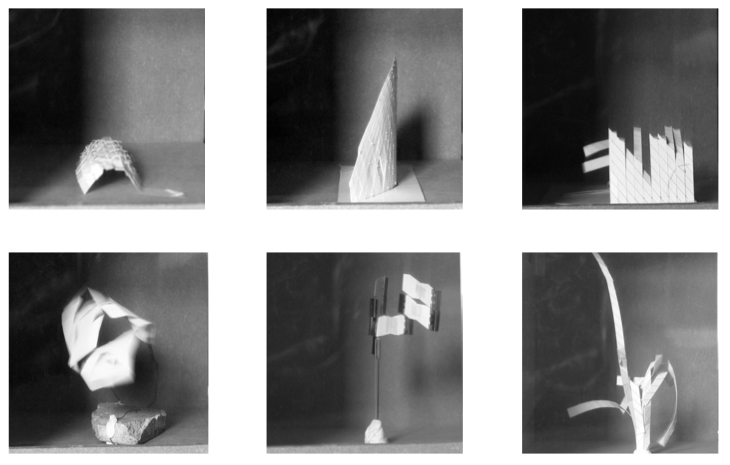
Variations of openings in the material (cardboard) - flexibility

(Sorted out in the final book because it did not had a big influence on the further development of the project but it does of cause have a big influence on our process and the direction of the project as it shows that we have take another material in to consideration and in that context we come up with the idea with a flexible material which are controlled by rigid elements which gives the material different behaviors depending on the shape of the props)
Wednesday, October 16, 2013
Notes - probes
Summary of discussion about which kind of structure we should investigate:
Investigation of how the structure will behave in wind when:
Static structure >< Dynamic cladding - will behave as in our earlier investigations
Dynamic structure >< Static cladding - We already know how a structure can be dynamic/changed from phase 2 in our case study archive where group five was working with dynamic structures.
Dynamic structure >< Dynamic cladding: We will on the basis of above-mentioned work with this kind of structure in our investigation because we think this kind of structure both could give us the possibility to both work with a structure which moves in a greater or lesser extent and we can slice in the structure and make it possible for the structure to open up in certain areas and be closed in others. etc.
We have decided to focus on one of these structures to get a better chance to investigate more specific subjects to the structure's behavior both in relation to material - which kind of material can be dynamic when it is un-frozen and static (remain in differently dynamic forms) when it is frozen and how can it be formed and thereby behave in different ways.
And in relation to form; how can it be formed for instance angled according to the direction of the wind? How can it be wide open in some areas and closed in others? How can the modules vary between being dependent of the rest of the structure or being more independent? How should the structure be attached to the ground?
Etc.
Probe_2: Connection to the ground; stringed or directly
Probe_3: Materials: Wood, paper, glass(thick transparent paper), plastic
Preparation:
We need a box which can create turbulence wind for our probes
Summary of discussion about which kind of structure we should investigate:
Investigation of how the structure will behave in wind when:
Static structure >< Dynamic cladding - will behave as in our earlier investigations
Dynamic structure >< Static cladding - We already know how a structure can be dynamic/changed from phase 2 in our case study archive where group five was working with dynamic structures.
Dynamic structure >< Dynamic cladding: We will on the basis of above-mentioned work with this kind of structure in our investigation because we think this kind of structure both could give us the possibility to both work with a structure which moves in a greater or lesser extent and we can slice in the structure and make it possible for the structure to open up in certain areas and be closed in others. etc.
We have decided to focus on one of these structures to get a better chance to investigate more specific subjects to the structure's behavior both in relation to material - which kind of material can be dynamic when it is un-frozen and static (remain in differently dynamic forms) when it is frozen and how can it be formed and thereby behave in different ways.
And in relation to form; how can it be formed for instance angled according to the direction of the wind? How can it be wide open in some areas and closed in others? How can the modules vary between being dependent of the rest of the structure or being more independent? How should the structure be attached to the ground?
Etc.
Proposals to probes:
Probe_1: Form of the structureProbe_2: Connection to the ground; stringed or directly
Probe_3: Materials: Wood, paper, glass(thick transparent paper), plastic
We need a box which can create turbulence wind for our probes
Subscribe to:
Posts (Atom)